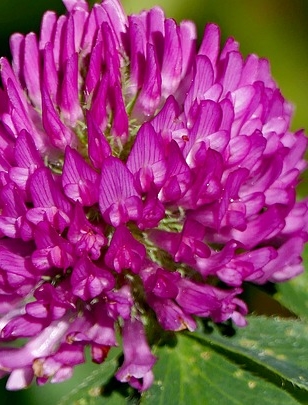
Red clover
Trifolium pratense
Traditionally, clover was a symbol of good luck, especially the four-leafed clover.
Should it be help up to a priest during a sermon without his knowledge, he will be prevented to coninue.
Should two people eat a four-leaved clover togehter, they are sure to fall in love.
However, it usually has only three leaves, in them people used to see the three aspects of the triune goddess or later then the triune god.
Throughout the history, it has also been kept as a charm to prevent madness.
Name: Red clover, Trifolium pratense
Other names: Meadow clover, bumblebee clover, forage clover
Family: Butterfly family (Fabaceae)
Harvest months: Mar-Sep
Usable plant parts: Leaves, flowers
Leaf shape: trifoliate
Flower color: pink, red
Habitat: moist meadows, roadsides, forest clearings
Toxicity: non-toxic
Ingredients: asparagine, coumarins, flavonoids, glycosides, potassium, calcium, magnesium, phytohormones, salicin, vitamin B1, vitamin B3, vitamin C
Properties: blood purifying, anti-inflammatory, diuretic, antispasmodic
Helps with: eye ailments, bronchitis, chest inflammation, sore throat, high cholesterol, cough, bone loss, liver weakness, menstrual cramps, prostate problems, menopausal symptoms, white discharge, bleeding gums
Plant uses
Cooking:
They have a faint bean-like taste and can be added to a salad, soups, stews,
and other dishes such as lasagna.
Health:
Red clover contains plant hormones, so-called phytohormones.
These are similar to the human hormone estrogen and are therefore called phytoestrogens.
They can balance our hormone levels and therefore help with both estrogen deficiency and excess.
It does a fabulous job at helping to cleanse the spleen by removing dead red blood cells.
Beauty:
Creams and ointments containing red clover counteract skin retention.
Red clover flowers increase the water storage capacity of skin cells, which leads to the reduction of wrinkles.