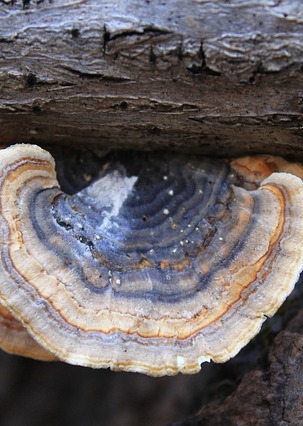
Turkey tail
Trametes versicolor
The Latin name versicolor means colorful, dazzling, and already reveals that the turkey tail is a real eye-catcher.

It was used in Parisian chic in the 19th century as jewelry and processed as a brooch, buckle, or skin jewelry and is still used decoratively in floristics today.

Their fan-like arranged fruit body even reminds a little of a butterfly.

Name: Name: Turkey tail, Trametes versicolor
Other names: Many-zoned polypore, Kawaratake, As yun zhi
Family: Polyporaceae
Harvest months: All year round
Usable plant parts: Fruiting body Description: It often grows in clusters where its fan-shaped caps are closely stacked
They can be green-black, blue, dark brown or ocher in color. The cap is wavy at the edge and slightly lobed.
The tubes of the underside are white and take on a brownish color when old. Habitat: On rotten wood, common in central Europe
Risk of confusion: none Toxicity: non-toxic
Warning: none Ingredients: polysaccharide K, beta-glucans, polysaccharide PSK, glycoprotein PSP, ergosterols
Properties: immunostimulant, antitumoral, antiviral, antibacterial, antifungal, antioxidant,
Helps with: gastrointestinal cancer, lung cancer, esophageal - throat cancer, nasopharyngeal cancer, breast cancer, cervical cancer, leukemia
Plant uses
Cooking:
The Turkey tail is edible. Their flesh is tough and fibrous. Young Turkey tails with white undersides are relatively tasteless, older specimens have a subtle fishy flavor.

Health:
It can reduce the growth of tumors and prevent new ones. Additionally, it can lessen the side effects of chemotherapy and radiation. The mushroom can fight infections and diseases such as herpes and hepatitis.

Beauty:
None.