Oyster mushroom
Pleurotus ostreatus
The oyster mushroom has its place in regional and international cuisine
as well as in natural medicine.
While it still got our ancestors through the winter months as a daily yield,
it has moved into the shadow of other cultivated mushrooms in Europe in recent decades.
In Asia, the easy-to-cultivate edible mushroom is valued for its umami flavor intensity.
In nature it is mainly found on dead wood, in cultivation it is satisfied with wood, paper, and straw.
Name: Oyster mushroom, Pleurotus ostreatus
Other names: Oyster Shelf, Tree Oyster, Tamogitake, Straw Mushroom
Family: Pleurotaceae
When to harvest: All year long
Usable parts: fruiting body, cap, stipe
Description:
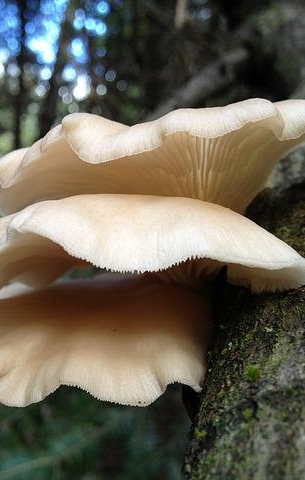
Its cap is fan or oyster-shaped and broad. Can be from 5–25cm in length.
The color is often white or grey but sometimes tan-colored in places. Its cap skin is smooth and slightly glossy
Its gills are white or cream, later yellowish.
Its stipe can be missing from specimens but is often off-center and is short and thick. The surface of the stipe is subtly velvety to tomentose, sometimes with a ragged base.
The spores are white or grey and are cylindric-ellipsoid, smooth.
Habitant: On living or dead wood and hardwood trees, particularly deciduous trees, such as beech.
Risk of confusion: Sarcomyxa serotina, Pleurocybella porridges
Toxicity: non-toxic
Warning: Caution is advised when taking oyster mushrooms at the same time as protease inhibitors,
which are used, for example, as antihypertensives or to fight viruses.
This can lead to an increased concentration of statin, which upsets the fat and cholesterol metabolism.
Ingredients: glutamic acid, vitamin D, beta-glucan pleuran, niacin, iron, zinc, selenium
Properties: antioxidant, immune-supportive, antiviral, antibacterial, anti-inflammatory
Helps with: reducing liver damage, inflammations, oxidative damage
Plant uses
Cooking:
The oyster mushroom is a true delicacy.
The aroma reminds some of the veal, others of chicken.
In dishes, the oyster mushroom intensifies the flavor of the ingredients.
This is due to the abundant amount of glutamic acid, which acts as a free amino acid flavor enhancer.
Health:
It contains vitamin D, which supports the regeneration of bones and cartilage and can prevent
osteoporosis. One of these polysaccharides, beta-glucan pleuran,
is also responsible for the anti-inflammatory effect of the oyster mushroom,
which can provide relief from intestinal inflammation, arthritis, prostatitis,
and autoimmune diseases, among others.
Beauty:
In recent years, the antioxidant effect of the mushroom has led to its marketing
as an anti-aging agent, where mainly mushroom extracts are used.