Birch polypore
Piptoporus betulinus
The first time mankind recorded the use of the birch polypore dates back 5000 years.
Even the Stone Age glacier mummy "Ötzi" found in the Ötztal Alps carried two birch spores with him,
which is why the mushroom is also known today as the Ötzi mushroom.
In America and Europe, there is evidence that this fungus was often used as a snuff powder in the past.
In traditional Chinese medicine (TCM) it is known as Hua Bo Guan Jun.
Name: Birch polypore, Fomitopsis betulina (since 2015), Piptoporus betulinus
Other names: Birch bracket, Birch conk, Razor strop, Hua Bo Guan Jun
Family: Fomitopsidaceae (tree sponge relatives)
Harvest months: All year round
Usable plant parts: Hat, stem
Appearance:
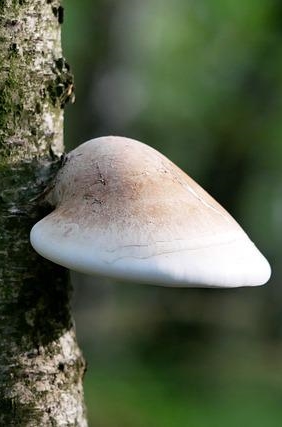
When young, the fruiting bodies of the birch spore push out of the birch bark as white, roundish nodules.
With age, the mushroom increases significantly in size.
The surface is smooth and velvety, sometimes slightly or more humped.
The underside of the birch spore is white and covered with many small pores.
When young, these are barely visible or not visible at all.
Habitant: In mixed forests of the northern hemisphere. Exclusively on birch trees.
Risk of confusion: Fire sponge, Tinder sponge, Bulging lacquer spore, Dark lacquer spore, Sap spores
Toxicity: non-toxic
Warning : none
Ingredients: beta carotene, betulin, betulinic acid, iron, heteroglycan, potassium, copper, phosphorus, selenium, triterpenes, vitamin B, vitamin C
Properties: antibacterial, anticarcinogenic, antiviral, hemostatic, anti-inflammatory
Helps with: Intestinal parasites, hair loss, cancer, gastritis, heartburn, indigestion
Plant uses
Cooking:
The birch polypore is listed in the literature as an inedible vital fungus because it is edible but not very aromatic.
Health:
The Birch polypore has general anti-inflammatory, antibiotic, antiviral, and hemostatic effects.
The proven medicinal mushroom expert Hans-Heinrich Kunde recommends the Birch polypore
for the treatment of stomach weakness, stomach upsets, stomach irritations,
gastritis, stomach ulcers and as a prophylactic for healthy digestion.
Beauty:
None.