Almond mushroom
Agaricus bisporus
The name champignon comes from the French because there was a nursery of European cultivation
of this mushroom.
A melon farmer observed at the beginning of the 17th century that on the melon waste,
on which also the washing-up water of wild mushrooms from his kitchen landed,
these very mushrooms grew particularly luxuriantly.
From France, in the middle of the 17th century,
the Champignon de Paris started its triumphal procession around the globe.
The first precise cultivation instructions were published in 1651 in the gardening book
"The French Gardener".
From that time to the present, an enormous development in the cultivation of the mushroom took place.
Name: mushroom, Agaricus bisporus
Other names: almond mushroom, mushroom of the sun, God's mushroom, mushroom of life, royal sun agaricus, himematsutake
Family: Agaricaceae
Harvest months: Jun-Oct
Usable plant parts: Fruiting body, stalk
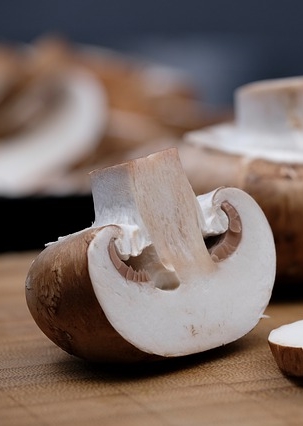
Appearance: Whitish to brown color
Young caps are hemispherical, older caps increasingly flatten out
Diameter from 5 to 16 cm
the edge is initially tucked inward, then lowered down
Length of the stem is from 3-8 cm, the thickness 1-4cm
Habitant: Meadows, pastures, fields
Toxicity: non-toxic
Warning: Contains small amounts of agaritin, which is carcinogenic in animal studies.
Therefore, the mushrooms should not be eaten raw.
Ingredients: contains up to 40% protein, rich in unsaturated fatty acids,
magnesium, calcium, phosphorus, B vitamins, vitamin A, vitamin C, vitamin D,
vitamin E, vitamin K, beta-glucans
Properties: immunostimulant, anticancer, antioxidant, liver protective, blood pressure stabilizing, anti-aging
Helps with: protects cells from oxidative damage, anti-aging
Plant uses
Cooking:
It is edible with a somewhat sweet and almondy taste.
Health:
Acts against bloating, skin problems, reduces the unpleasant smell of sweat,
increases the production of melanin and thus protects against UV radiation.
Beauty:
None.